

Evidence, not guesswork
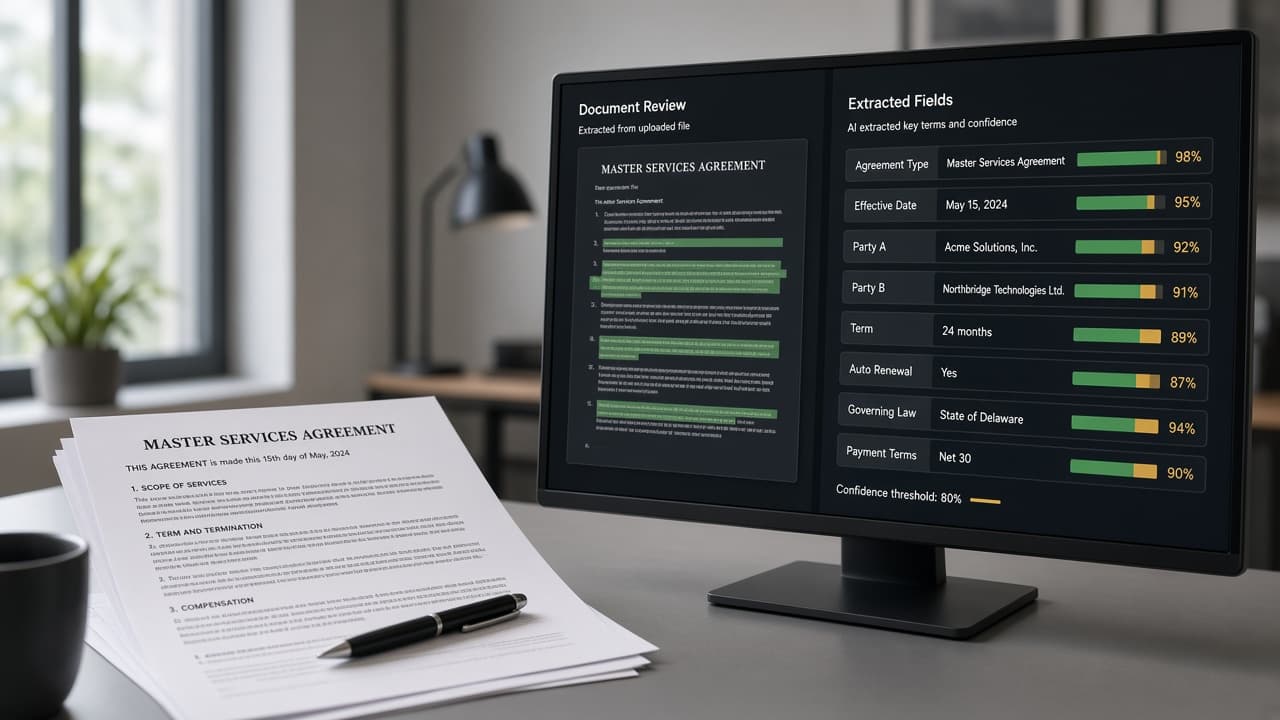
Every field links back to the source page — so review is verification, not archaeology.
Federal contract agents
Agents that read awards, solicitations and modifications: every CLIN, funding line, clause and award field is boxed on its page, sent to a reviewer when it can’t be trusted, and exported Oracle-ready.
ExtractEvery value is boxed on its source page. Low-confidence fields route to a reviewer.
Works with the systems federal teams already run
Every field links back to the source page — so review is verification, not archaeology.
Extraction, confidence, and human review are governed so outputs are ready for downstream systems.
Audit trails, review queues, and Oracle-ready staging — designed for regulated workflows.
Extraction agent
The agent reads the form blocks, CLIN schedule and clause list with rules and page layout, scores every value, and hands you only the ones it can't stand behind.
DataoAI
Ask in plain English across one contract or the whole repository. Answers come from extracted fields, clause references and the contract text, and each citation opens the source page with the passage highlighted.
Obligations, playbook and rules
Deadlines and duties come out of schedules, clauses and text. A clause playbook and validation rules check every contract the same way, and deviations are flagged before export.
Agent actions
Executive summary, risk register, clause gap report, obligations register and funding reconciliation, built from the reviewed staging data and downloadable as CSV or Markdown.
Confidence, plainly
The score doesn't claim accuracy. It summarizes how the value was found: the extraction method, whether it validates, whether it's on the cited page, and whether anything competes with it. Nothing is auto-accepted unless an administrator turns that on.
Pick a band to see where the sample contract's values land.
3 of 20 sample values are low; 3 go to the review queue.
Each value gets a score and a band. Any routing reason sends it to the review queue with that reason attached.
A reviewer accepts, corrects, or rejects it with the source page beside the value. A correction never overwrites the original extraction.
Every decision goes into an append-only log with the reviewer's ID and role, the value before and after, and when it happened.
Only accepted or corrected values reach the Oracle staging export. Pending values are skipped, and live sends are off by default.
What one audit entry records
Example · append-only, never edited| Timestamp | Reviewer | Field | Before → After | Reason |
|---|---|---|---|---|
| 2026-08-20 14:32:07 UTC | reviewer-0042 · Contract Specialist | ISSUED BY | — (2 candidates) → Sample Contracting Activity | Corrected: chose the activity name over the street line, page 1 |
Clause playbook
Add a clause you expect, prohibit, or want a second look at. It's checked against the clauses the sample contract actually cites, the same way every processed contract is.
Clauses cited in the sample contract
Why not a generic assistant
A general OCR tool or chat assistant can read a contract. Dataomatix is built so that every value can be checked before it's used.
| Question | Generic OCR / chat assistant | Dataomatix |
|---|---|---|
| Where a value came from | Text output, sometimes with a page number | Boxed on the source page, with page, region and method |
| When it isn't sure | Returns its best guess | Sends the field to a reviewer with the reason |
| Repeating records (CLINs, funding, clauses) | Flattened into prose or one long table | One record per row, with the source's own column headings |
| Corrections | Lost when you re-run the prompt | Append-only audit trail; exports use the reviewed value |
| FAR / DFARS coverage | Whatever the model happens to recall | Clause references matched to the FAR and checked against your playbook |
| Downstream systems | Copy and paste | Staging workbook, CSV/Excel and an Oracle payload preview behind RBAC |
Trust & deployment
Federal teams ask about deployment before they ask about accuracy, so each answer carries its status: available now, or not there yet.
Form fields, CLINs, funding lines, and FAR/DFARS clauses come from rules and page layout, not a model. You can turn the AI fallback off entirely.
When the fallback is on, it calls Gemini, OpenAI, or a local Ollama model on your own endpoint. Ollama keeps document text on your network.
The API and web app ship as Docker images behind nginx, so you can run them in your own cloud account, including GovCloud, with your own Postgres and storage.
Every review decision is append-only and records the reviewer's ID, role, the value before and after, the reason, and the time.
With the AI fallback off or on Ollama, local Tesseract OCR, and local storage, no step needs the internet. It hasn't been tested inside an enclave yet.
Dataomatix has no FedRAMP authorization of its own. For federal workloads, deploy it inside an environment that already holds the ATO you need.
What a federal buyer can do today, and what isn't done yet.
Run inside an authorized boundary
Self-host the Docker images in a cloud region that already holds a FedRAMP High authorization, such as AWS GovCloud (US) or Azure Government, under your agency's ATO.
Inherit infrastructure controls
Hosting, network and physical controls come from the provider's package. Your security team documents the application layer: RBAC, the append-only audit log, and the AI fallback set to off or to a local model.
Validate an isolated deployment
Offline operation with local OCR and storage works by design but hasn't been tested inside an enclave.
Dataomatix's own FedRAMP authorization
Not started, and no timeline is committed. Until it exists, use the inherited path above.
Proof & scale
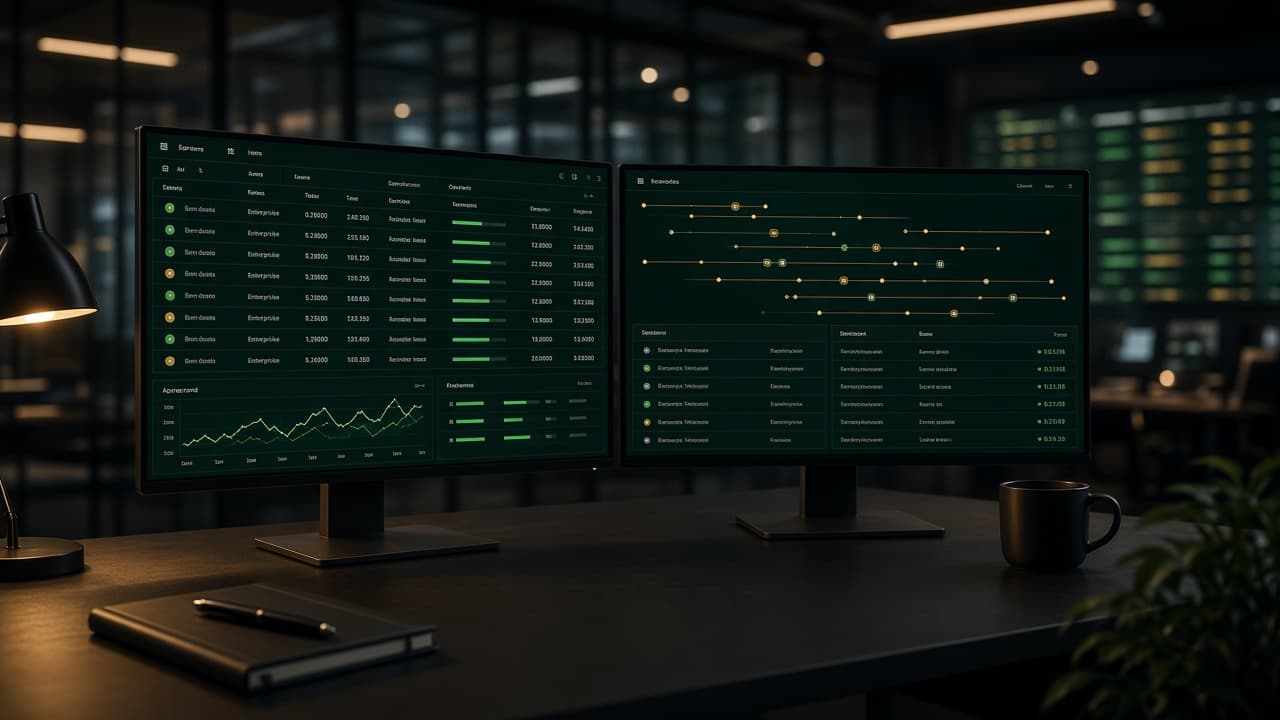
1,284
Documents
1,197
Completed
23
Review required
4
Processing
96%
Extraction accuracy
41s
Avg processing
8.4%
Human review rate
61,870
Fields extracted